
Department of Anatomy
- About Department
- Cadaveric Skill Lab
- Infrastructure
- Curriculum
- Student Support & Progression
- Publications
- Brochure
Goals
The broad goal in the teaching of undergraduate students in Anatomy aims at
- To provide a basis for understanding the clinical correlation of organs or structures involved and the anatomical basis for the disease presentations.
- Providing comprehensive knowledge of the gross and microscopic structures and development of human body.
Objectives
Knowledge
- Analyze the integrative and regulative functions of the organs and systems.
- He/she shall be able to locate the site of gross lesions according to the deficits
encountered. - Demonstrate knowledge of the basic principles and sequential development of the organs and systems,
- Recognize the critical stages of development, the effects of common teratogens, genetic mutations and environmental hazards.
- He/she shall be able to explain the developmental basis of the major variations and
abnormalities.
Skills
- Identify and locate all the structures of the body and mark the topography of the living anatomy.
- Identify the organs and tissues under the microscope.
- Understand the principles of karyotyping and identify the gross congenital anomalies.
- Understand principles of newer imaging techniques and interpretation of CT scan,
sonogram etc. - Understand clinical basis of some common clinical procedures i.e. intramuscular and
intravenous injection, lumbar puncture and kidney biopsy etc.
Integration
- Comprehend the regulation and integration of the functions of the organs and systems in the body.
- Thus interpret the anatomical basis of disease process.
Infrastructure
| Name | Size |
|---|---|
| Professor & Head | 5.24 x 4.41 = 23.10 Sq. m |
| Professor 1 | 5.31 x 3.17 = 16.83 Sq. m |
| Professor 2 | 5.31 x 5.04 = 26.76 Sq. m |
| Associate Professor | 3.10 x 5.23 = 16.21 Sq. m |
| Assistant Professor | 5.31 x 3.17 x 2 = 16.83 Sq. m |
| Tutors / Demonstrators | 5.31 x 5.04 = 26.76 Sq. m |
| Departmental Office | 5.31 x 3.17 = 16.83 Sq. m |
| Library Cum-Seminar Room | 5.31 x 6.35 = 34 Sq. m |
| Non-Teaching Room | 5.31 x 3.17 = 16.83 Sq. m |
| Dissection Hall | 19.31 x 19.27 = 372.10 Sq. m |
| Lecture Hall 2 | 19.35 x 19.27 = 372.87 Sq. m |
| Histology Lab | 12.85 x 19.27 = 247.61 Sq. m |
| Museum | 12.81 x 19.27 = 246.84 Sq. m |
| Demo I & II | 10.62 x 6.35 = 67.43 Sq. m |
| Research Lab | 10.62 x 6.35 = 67.43 Sq. m |
Infrastructure: Departmental Library
| Category | Details |
|---|---|
| Anatomy Books (Central Library) | 1045 |
| Anatomy Books (Departmental Library) | 120 |
| Journal | Journal of Anatomical Society of India |
| e-Consortia (Books & Journals) | Elsevier & DELNET e-consortia |
Dept: Equipment’s / Teaching aids
Department is equipped with-
Department is equipped with-
- LCD Projectors: 5
- OHP Projectors: 2
- Computers: 10 connected to internet
- Printers – 3
- Scanner with printer-1
- Cooling (40C) cabinets – total capacity for 15 cadavers
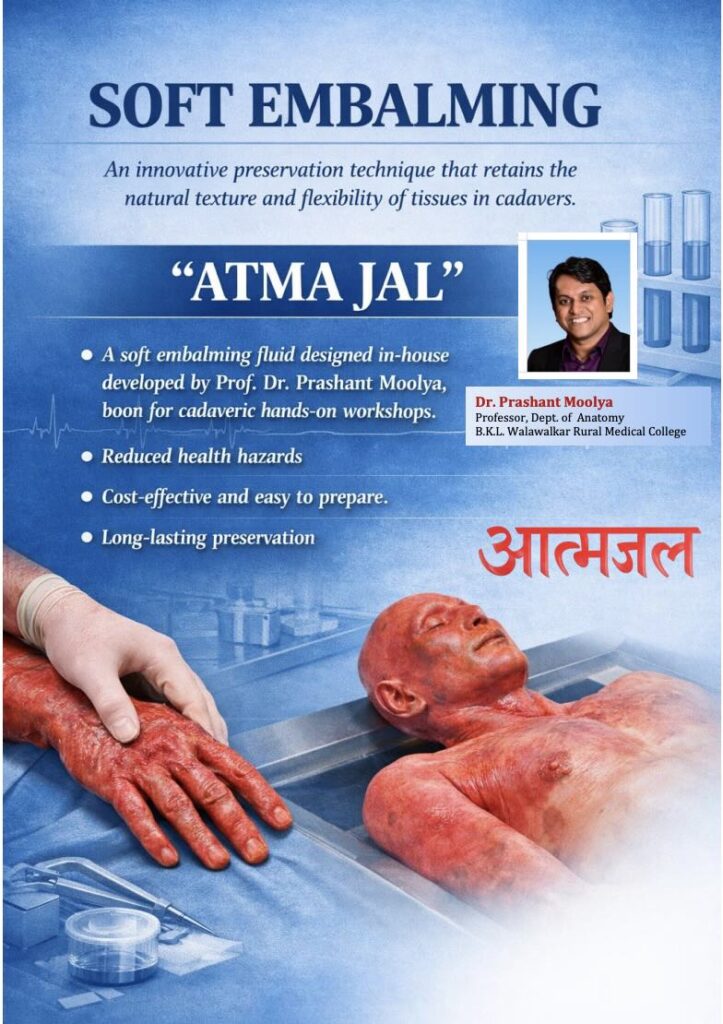
- Embalming machines
- Takara Sound system- for dissection hall
- All other equipment’s as per NMC norms
- The department adheres to the NMC and MUHS, Nashik norms for undergraduate education.
- New CBME curriculum has been implemented from 2019.
–Orientation Programme
–Foundation Course
–Students feedback
–Early clinical exposure
–ATECOM
- Departmental level Seminars, Poster competitions are conducted under the guidance of faculty.
- All faculty use ICT to support & enhance the delivery of classroom teaching.
- Dissection hall, histology laboratory, demo rooms, museum are ICT enabled.
- Dissection hall is equipped with Takara sound system
- Continuous Internal Evaluation (CIE) is carried out by internal assessment (formative) examinations.
- Part completion/weekly tests are carried out regularly.
- During COVID-19 online classes were conducted.
- OSPE
- Parent – Teacher Meetings help to understand students’ progression & problems.
- Monthly attendance & Performance is informed to students as well as to parents.
- Anatomy Elective postings for III/I MBBS are in the fields of neuro-anatomy;
research oriented and hands on practice. - Remedial teaching for Slow learners
- Coaching for Advanced learners
- Students feedback provide us input and actions
| Author(s) | Title | Journal / Publication Details | Indexed In | Role | Year |
|---|---|---|---|---|---|
| Dr. Prashant Moolya | A cadaveric study of variations of renal artery from Nashik, Maharashtra India | Journal of Clinical and Diagnostic Research, 2022 Dec, Vol.16 (12): AC05-ACO9 | DOAJ, Embase | 2nd & Corresponding | Dec 2022 |
| Dr. Vrushali Bhandare | Prediction of Height Using Hand and Foot Parameters in Maharashtrian Population | National Journal of Clinical Anatomy, Volume 11, Issue 3, July–September 2022, Page 143-7 | PubMed | 1st | July-Sep 2022 |
| Dr. Prashant Moolya | Role of Axillary Arch Muscle in Neurovascular Compression: A Cadaveric Study in the Western Region of Maharashtra, India | International Journal of Anatomy Radiology and Surgery. 2022 July, Vol-11(3): AO33-AO36 | DOAJ | 1st | July 2022 |
| Ms. Swati More | Sexual Dimorphism in Cervical Spine – A Magnetic Resonance Imaging Study | Journal of Datta Meghe Institute of Medical Sciences University, Jan-March 2022, Vol 17, Pages 38-42 | UGC Approved | 1st | Jan-March 2022 |
| Ms. Swati More | Age Identification From Appearance of Pisiform Bone: A Radiological Study | International Journal of Medical Sciences and Current Research (IJMSCR), Vol 5, Issue 2, Page 1218–1224 | PubMed | 1st | 2022 |
| Dr. Vrushali Bhandare | Morphological and Morphometric Analysis of Talar Articular Facets in Human Calcanei in Maharashtrian Populaton – A Descriptive Study | International Journal of Medical Sciences and Innovative Research (IJMSIR), Vol 7, Issue 1, January 2022, Page 209-215 | DOAJ | 2nd | Jan 2022 |
| Khayinmi W.S | Therapeutic potential of Mucuna pruriens (Linn.) on high-fat diet-induced testicular and sperm damage in rats | Avicenna Journal of Phytomedicine | Scopus | 3rd | 2022 |
| Khayinmi W.S | Testosterone Influence on Microtubule Associated Proteins and Spine Density in Hippocampus: Implications on Learning and Memory | Developmental Neuroscience | PubMed | 3rd | 2022 |
| Dr. Prashant Moolya | A Topographical Study of Nutrient Foramen in Human Fibulae | International Journal of Anatomy Radiology and Surgery, IJARS 2021 Oct, Vol-10(4): AO61-AO64 | DOAJ, Index Copernicus | 1st | Oct 2021 |
| Dr. Pushpa Burute | Role of TP53 Gene Polymorphism in Male Infertility | International Journal of Infertility and Fetal Medicine, Volume 12, Issue 2 | Scopus, Google Scholar | 4th | May-Aug 2021 |
| Dr. Avinash Shewale | Histochemical study of mucosubstances in normal human vermiform appendix | MedPulse International Journal of Anatomy. March 2021; 17(3): 24-26 | PubMed, Index Copernicus | 1st | March 2021 |
| Dr. Avinash Shewale | Histogenesis of human fetal pancreas | MedPulse International Journal of Anatomy. February 2021; 17(2): 09-11 | PubMed, Index Copernicus | 2nd | Feb 2021 |
| Dr. Pushpa Burute | Anthopometric analysis of human dry patella for construction of patellar prosthesis: A pilot study | International Journal of Anatomy Vol. 9(1): A006 – A008 | Index Copernicus | 3rd | Jan 2020 |
| Ms. Swati More | An Additional Head of Biceps Femoris: A Case Report | Indian Journal of Anatomy | Index Copernicus | 1st | 2019 |
| Khayinmi W.S | Therapeutic potential of Mucuna pruriens (Linn.) on ageing induced damage in dorsal nerve of the penis | The Aging Male | PubMed | Corresponding | 2019 |
| Dr. Avinash Shewale | The morphometric study of the jugular foramen in human adult skulls of Western Maharashtra | MedPulse – International Journal of Anatomy, Vol 7, Issue 2, August 2018 | PubMed, Google Scholar | 1st | Aug 2018 |
| Dr. Datta Nandanvankar | A qualitative study of palmar dermatographics in congenital heart diseases | Indian Journal of Anatomy Volume 7, Number 4 | Index Copernicus | 2nd | Aug 2018 |
| Dr. Avinash Shewale | Variations in carotico clinoid foramen in human skulls in western Maharashtra | MedPulse – International Journal of Anatomy, Vol 6, Issue 3, June 2018 | PubMed, Google Scholar | 2nd | July 2018 |
| Dr. Pushpa Burute | Supratrochlear Foramen; Morphological Correlation and Clinical Significance | Indian Journal of Anatomy Vol 5 Number 3 | Index Copernicus | 1st | Dec 2016 |
| Dr. Avinash Shewale | Study of Variations in the Divisions, Course and Termination of the Sciatic Nerve | Journal of Krishna Institute of Medical Sciences University, Vol. 2, No. 1 | Scopus, Google Scholar | 1st | Jan-June 2013 |
Click Here to view brochure